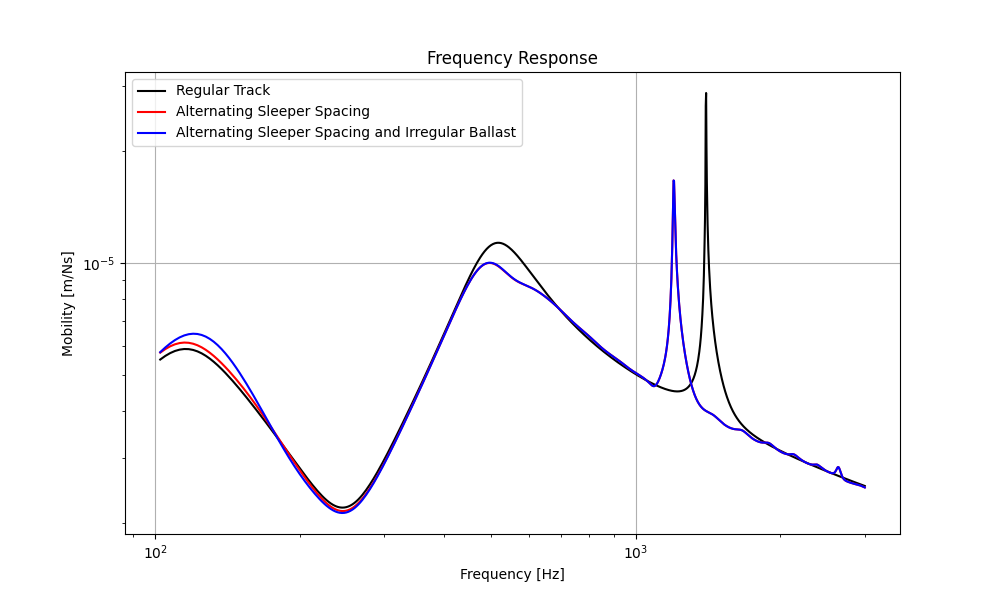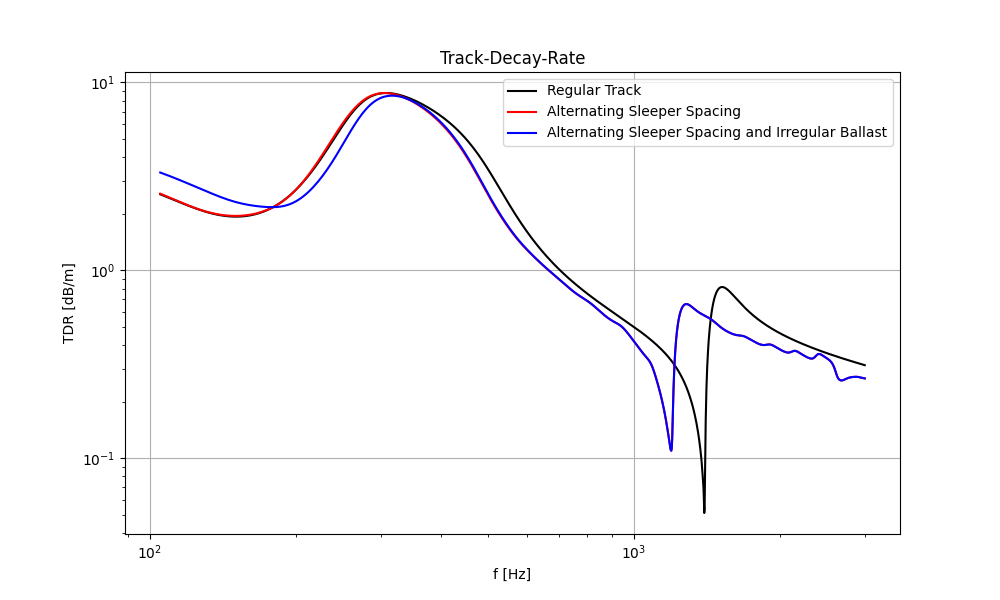
Apply Structural Disorder
Structural disorder in railway tracks can significantly affect the vibration characteristics of the track (see Mantel et al. [2]). This example demonstrates how to set up and run a basic simulation using the Rolland library to calculate the frequency response of different railway tracks with varying structural properties.
Note
This example only determines the track response and the TDR (Track Decay Rate) for a single excitation point! It is recommended to average the results over multiple excitation points to obtain a more accurate representation of the track’s response.
Python Code
  1  """
  2  Comparative Track Vibration Analysis using Rolland API
  3
  4  This example demonstrates a comparison of vibration characteristics for:
  5      1. Discrete ballasted track (equally spaced mounting positions, equal mounting properties)
  6      2. Discrete ballasted track (non-uniform mounting positions, equal mounting properties)
  7      3. Discrete ballasted track (non-uniform mounting positions, irregular ballast stiffness)
  8  """
  9
 10  # Import required components from Rolland library
 11  from rolland.postprocessing import Response as resp
 12  from rolland.postprocessing import TDR
 13  from rolland import (
 14      ContSlabSingleRailTrack,
 15      ContBallastedSingleRailTrack,
 16      SimplePeriodicSlabSingleRailTrack,
 17      SimplePeriodicBallastedSingleRailTrack, ArrangedBallastedSingleRailTrack, PeriodicArrangement, RandomArrangement
 18  )
 19  from rolland import DiscrPad, Sleeper, Ballast, ContPad, Slab
 20  from rolland import PMLRailDampVertic, DiscretizationEBBVerticConst
 21  from rolland import DeflectionEBBVertic, GaussianImpulse
 22  from rolland.database.rail.db_rail import UIC60
 23
 24  # 1. TRACK DEFINITIONS ---------------------------------------------------------
 25
 26  pad = DiscrPad(sp=[300*10**6, 0], dp=[30000, 0])    # Pad instance
 27  sleep = Sleeper(ms=150)                             # Sleeper instance
 28  ball = Ballast(sb=[100*10**6, 0], db=[80000, 0])    # Ballast instance
 29  dist1 = 0.6                                         # 1st sleeper spacing [m]
 30  dist2 = 0.7                                         # 2nd sleeper spacing [m]
 31
 32  num_mount = 243
 33
 34  # 1.1 Discrete ballasted track (equally spaced mounting positions, equal mounting properties)
 35  track1 = SimplePeriodicBallastedSingleRailTrack(
 36      rail=UIC60,                                         # Standard rail profile
 37      pad=pad,
 38      sleeper=sleep,
 39      ballast=ball,
 40      num_mount=num_mount,                                # Number of mounting positions
 41      distance=dist1
 42  )
 43
 44  # 1.2 Discrete ballasted track (non-uniform mounting positions, equal mounting properties)
 45  track2 = ArrangedBallastedSingleRailTrack(
 46      rail=UIC60,
 47      pad=PeriodicArrangement(item=[pad]),                # No irregularity due to single item
 48      sleeper=PeriodicArrangement(item=[sleep]),
 49      ballast=PeriodicArrangement(item=[ball]),
 50      num_mount=num_mount,
 51      distance=PeriodicArrangement(item=[dist1, dist2])   # Periodic alternation of dist1 and dist2
 52  )
 53
 54  # 1.3 Discrete ballasted track (non-uniform mounting positions, irregular ballast stiffness)
 55
 56  # Generate normal distributed Ballast instances
 57  ball_normal = [Ballast(
 58              sb=[RandomArrangement.trunc_norm(mean=100, sd=30, minv=70, max_v=130) * 10 ** 6, 0],
 59              db=[80000, 0]
 60              ) for _ in range(num_mount)]
 61
 62  track3 = ArrangedBallastedSingleRailTrack(
 63      rail=UIC60,
 64      pad=RandomArrangement(item=[pad]),
 65      sleeper=RandomArrangement(item=[sleep]),
 66      ballast=RandomArrangement(item=ball_normal),    # Insert list of Ballast instances
 67      num_mount=num_mount,
 68      distance=PeriodicArrangement(item=[dist1, dist2]),
 69  )
 70
 71  # 2. BOUNDARY CONDITIONS ------------------------------------------------------
 72  # Perfectly Matched Layer absorbing boundaries
 73  bound = PMLRailDampVertic(l_bound=33.0)             # 33.0 m boundary domain
 74
 75  # 3. EXCITATION SETUP ---------------------------------------------------------
 76  # Gaussian impulse at the same position for all tracks
 77  x_excit = 71.7                                      # Excitation position [m]
 78  excit = GaussianImpulse(x_excit=x_excit)
 79
 80  # 4. SIMULATION SETUP & EXECUTION ----------------------------------------------
 81  # Discretize and simulate each track type
 82  discr1 = DiscretizationEBBVerticConst(track=track1, bound=bound)
 83  discr2 = DiscretizationEBBVerticConst(track=track2, bound=bound)
 84  discr3 = DiscretizationEBBVerticConst(track=track3, bound=bound)
 85
 86  defl1 = DeflectionEBBVertic(discr=discr1, excit=excit)
 87  defl2 = DeflectionEBBVertic(discr=discr2, excit=excit)
 88  defl3 = DeflectionEBBVertic(discr=discr3, excit=excit)
 89
 90  # 5. POSTPROCESSING & COMPARISON ----------------------------------------------
 91  # 5.1 Calculate frequency responses for each track at the excitation point
 92  pp1 = resp(results=defl1)
 93  pp2 = resp(results=defl2)
 94  pp3 = resp(results=defl3)
 95
 96  resp.plot(
 97      [(pp1.freq, abs(pp1.mob)),
 98       (pp2.freq, abs(pp2.mob)),
 99       (pp3.freq, abs(pp3.mob))],
100      ['Regular Track',
101       'Alternating Sleeper Spacing',
102       'Alternating Sleeper Spacing and Irregular Ballast'],
103      title='Frequency Response',
104      x_label='Frequency [Hz]',
105      y_label='Mobility [m/Ns]',
106  )
107
108  # 5.2 Calculate Track Decay Rate (TDR) for each track
109  tdr1 = TDR(results=defl1)
110  tdr2 = TDR(results=defl2)
111  tdr3 = TDR(results=defl3)
112
113  # Plot TDR for each track type
114  TDR.plot([(tdr1.freq, tdr1.tdr), (tdr2.freq, tdr2.tdr), (tdr3.freq, tdr3.tdr)],
115           ['Regular Track',
116            'Alternating Sleeper Spacing',
117            'Alternating Sleeper Spacing and Irregular Ballast'],
118       'Track-Decay-Rate', 'f [Hz]', 'TDR [dB/m]', plot_type='loglog')